
Tenses are one of the most important parts of English grammar. They help us understand the time of an action, whether it is happening now, happened in the past, or will happen in the future. If you want to speak or write English correctly, learning tenses is very important. Many students find tenses difficult, but with simple explanations and regular practice, they become easy to understand. In this article, we will explain what tenses are, why they are important, and the main types of tenses with easy examples. This guide will help beginners build a strong grammar foundation and improve their English speaking and writing skills.
What Are Tenses in English Grammar?
Tenses show the time of an action or event. They tell us whether something is happening in the present, happened in the past, or will happen in the future. For example, “I eat” shows present time, “I ate” shows past time, and “I will eat” shows future time. Tenses help make sentences clear and meaningful. Without proper tense usage, communication can become confusing. That is why understanding tenses is essential for speaking and writing correct English.
Why Are Tenses Important in English?
Tenses are important because they help us express actions at the right time. They make our communication clear, organized, and grammatically correct. By using tenses properly, we can talk about daily routines, past experiences, and future plans easily. Tenses are also essential in exams, job interviews, conversations, and writing tasks. A good understanding of tenses improves fluency, confidence, and sentence formation. That is why every English learner should practice tenses regularly.
The Three Main Types of Tenses
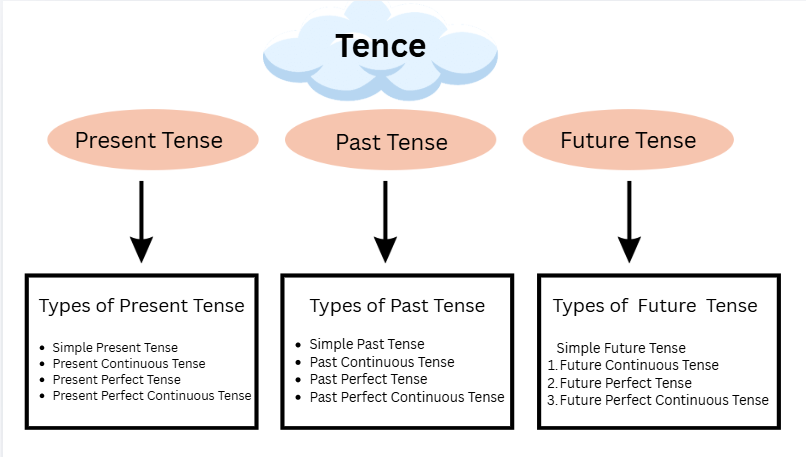
English tenses are mainly divided into three categories:
Present Tense
Used for actions happening now, daily habits, and general truths.
Past Tense
Used for actions that happened in the past.
Future Tense
Used for actions that will happen in the future.
Each main tense has four forms:
- Simple
- Continuous
- Perfect
- Perfect Continuous
So, in total, English grammar has 12 tenses.
Present Tense and Its Types
Present tense is used to talk about actions happening now, regular habits, facts, and routines.
Types of Present Tense
- Simple Present – I go to school every day.
- Present Continuous – I am going to school.
- Present Perfect – I have completed my homework.
- Present Perfect Continuous – I have been studying for two hours.
Present tense is commonly used in daily conversations and writing.
Past Tense and Its Types
Past tense is used to describe actions that already happened.
Types of Past Tense
- Simple Past – I visited Delhi last week.
- Past Continuous – I was studying at 8 PM.
- Past Perfect – I had finished my work before dinner.
- Past Perfect Continuous – I had been waiting for an hour.
Past tense helps us talk about previous experiences, stories, and completed actions.
Future Tense and Its Types
Future tense is used for actions that will happen later.
Types of Future Tense
- Simple Future – I will call you tomorrow.
- Future Continuous – I will be studying tonight.
- Future Perfect – I will have completed the task by evening.
- Future Perfect Continuous – I will have been working here for five years next month.
Future tense is useful when discussing plans, goals, and upcoming events.
Common Mistakes Students Make in Tenses
Many learners make mistakes while using tenses, especially when choosing the correct verb form. Some common mistakes include:
- Using present tense instead of past tense
- Forgetting helping verbs like is, am, are, has, have
- Mixing different tenses in one sentence
- Using incorrect verb forms
Regular practice and sentence examples can help avoid these mistakes.
Easy Tips to Learn Tenses Faster
Here are some simple tips to learn tenses:
- Start with simple present, past, and future tense
- Practice one tense at a time
- Make daily life examples
- Read grammar exercises
- Write 5 sentences for each tense
- Revise regularly
The more you practice, the easier tenses become.
Conclusion
Tenses are the foundation of English grammar and play an important role in speaking and writing correctly. They help us express actions clearly in the present, past, and future. By understanding the types of tenses, learning their rules, and practicing with examples, anyone can improve their grammar skills. Start with basic tenses, practice daily, and gradually move to advanced forms. With regular effort, you will find tenses easy and useful in everyday English communication.