
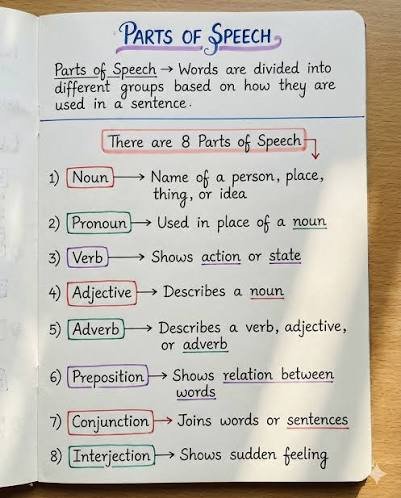
Parts of speech are one of the most important topics in English grammar. They help us understand how words work in a sentence. Every word in English belongs to a specific category, such as noun, pronoun, verb, adjective, adverb, preposition, conjunction, or interjection. Learning parts of speech is very important because it improves grammar, sentence formation, writing, and speaking skills. Many beginners find grammar difficult, but understanding parts of speech makes English easier to learn. In this article, we will explain what parts of speech are, why they are important, and the different types with simple examples. This guide will help students and beginners build a strong grammar foundation and improve their English communication skills.
What Are Parts of Speech in English Grammar?
Parts of speech are the categories of words based on their role in a sentence. Every word has a specific function. For example, some words name a person, place, or thing, while others show action, describe something, or connect ideas. Understanding parts of speech helps learners make correct sentences and use grammar properly. They are the basic building blocks of English grammar and are essential for both writing and speaking.
Why Are Parts of Speech Important in English?
Parts of speech are important because they help us understand how sentences are formed. When you know the role of each word, it becomes easier to speak correctly, write clearly, and avoid grammar mistakes. They also improve vocabulary, sentence structure, and overall communication. Whether you are a student, job seeker, or English learner, learning parts of speech is necessary for better grammar and confidence in English.
How Many Parts of Speech Are There?
In English grammar, there are 8 main parts of speech:
- Noun
- Pronoun
- Verb
- Adjective
- Adverb
- Preposition
- Conjunction
- Interjection
Each one has a different role in a sentence and helps make communication clear and meaningful.
Noun
A noun is a word that names a person, place, thing, or idea.
Examples of Nouns
- Person: teacher, doctor, Riya
- Place: school, market, Delhi
- Thing: book, table, pen
- Idea: honesty, love, happiness
Example Sentence:
Riya is reading a book in the classroom.
Nouns are one of the most commonly used parts of speech in English.
Pronoun
A pronoun is a word used in place of a noun. It helps avoid repeating the same noun again and again.
Examples of Pronouns
- I
- You
- He
- She
- It
- We
- They
Example Sentence:
Rohan is my friend. He is very kind.
Pronouns make sentences shorter, clearer, and easier to understand.
Verb
A verb is a word that shows action, state, or occurrence. It tells us what the subject is doing.
Examples of Verbs
- run
- eat
- write
- sing
- play
- is
- are
Example Sentence:
She writes a letter every day.
Without a verb, a sentence is usually incomplete because verbs are essential to express actions and events.
Adjective
An adjective is a word that describes a noun or pronoun. It gives more information about quality, size, color, shape, or number.
Examples of Adjectives
- beautiful
- tall
- red
- happy
- five
Example Sentence:
She is wearing a red dress.
Adjectives make our sentences more descriptive and interesting.
Adverb
An adverb is a word that describes a verb, adjective, or another adverb. It tells us how, when, where, or to what extent something happens.
Examples of Adverbs
- quickly
- slowly
- yesterday
- very
- here
Example Sentence:
He speaks English fluently.
Adverbs help us add more detail to our sentences.
Preposition
A preposition is a word that shows the relationship between a noun or pronoun and another word in the sentence.
Examples of Prepositions
- in
- on
- at
- under
- near
- behind
Example Sentence:
The book is on the table.
Prepositions help explain place, direction, and time in a sentence.
Conjunction
A conjunction is a word used to join words, phrases, or sentences.
Examples of Conjunctions
- and
- but
- because
- or
- so
Example Sentence:
I wanted to go outside, but it was raining.
Conjunctions help connect ideas smoothly in communication.
Interjection
An interjection is a word or phrase used to express sudden emotion or feeling.
Examples of Interjections
- Wow!
- Oh!
- Ouch!
- Hurrah!
- Alas!
Example Sentence:
Wow! That was an amazing performance.
Interjections are often used in spoken English to show feelings naturally.
Common Mistakes Students Make in Parts of Speech
Many learners make mistakes because they do not understand the function of words in a sentence. Some common mistakes include:
- Using an adjective in place of an adverb
- Confusing nouns and pronouns
- Using the wrong preposition
- Forgetting the main verb in a sentence
- Mixing conjunctions incorrectly
Regular practice and sentence examples can help students avoid these grammar mistakes.
Easy Tips to Learn Parts of Speech Faster
Here are some simple tips to learn parts of speech:
- Learn one part of speech at a time
- Read simple English sentences daily
- Underline nouns, verbs, and adjectives in a paragraph
- Make your own examples
- Practice grammar exercises regularly
- Revise the definitions again and again
The more you practice, the easier grammar becomes.
Conclusion
Parts of speech are the foundation of English grammar and help us understand how words function in a sentence. By learning nouns, pronouns, verbs, adjectives, adverbs, prepositions, conjunctions, and interjections, students can improve sentence formation, writing, and speaking skills. If you want to build strong grammar, start by understanding parts of speech and practice them daily with simple examples. With regular learning and revision, this topic will become easy and useful in everyday English communication.